Introduction: That "Off" Feeling Is Telling You Something
You know that nagging feeling — like you're going through the motions but nothing quite fits? Like you're busy, but not fulfilled? That's misalignment. Not laziness. And it's your intuition tapping you on the shoulder, asking you to pay attention.
That's exactly where I found myself recently. For a few weeks, I had been operating on autopilot, and slowly but surely, the energy drain added up. Skipping the gym. Feeling flat. Living in a low-grade funk I couldn't quite shake.
So I did something about it — and the shift was almost immediate.
The Wake-Up Call: Recognizing When You're Out of Alignment
Let's be honest: most of us don't realize we're off track until we've been off track for a while. It sneaks up on you. One skipped workout becomes a week. One late night becomes a pattern. One "I'll deal with it tomorrow" becomes a lifestyle.
Here's what misalignment can look like in real life:
- Dreading the start of your day instead of feeling excited
- Feeling busy but unproductive — lots of motion, little momentum
- Skipping habits that used to energize you (workouts, journaling, time outside)
- A general sense of "meh" that you can't quite explain
- Emotional flatness or low-grade irritability
Sound familiar? You're just overdue for a reset.
Not sure what's blocking your next level? Take the Next Level Blocker Quiz to identify exactly what's holding you back — so you can stop guessing and start moving.
The Fix: Ask Yourself One Powerful Question
Here's what I did when I hit my wall, and it's deceptively simple:
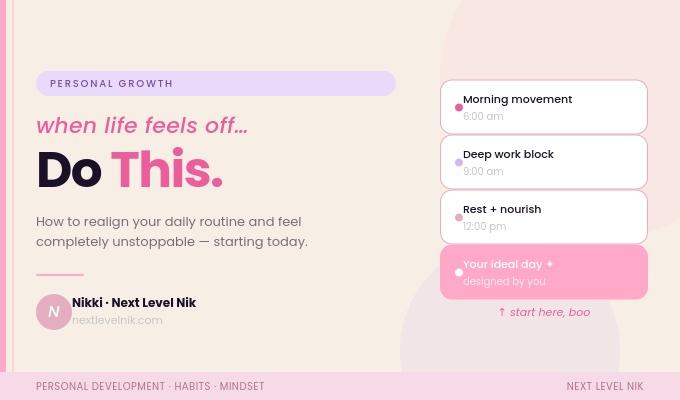
I asked myself: "What does my ideal day actually look like?"
Not the day I've been having. Not the day I think I should have. My ideal day — the one that fills me up, moves me forward, and feels like me.
Then I got specific. I looked at how I was dividing my time across the different categories of my life: health, work, rest, creativity, relationships. And I asked myself honestly — does how I'm spending my hours match what I actually value?
The answer was no. So I changed it.
How to Design Your Ideal Day (A Simple Framework)
You don't need a complicated system to realign your daily structure. Here's a quick process to try:
Step 1: Audit Your Current Day
Write down how you actually spend your time from morning to night. No judgment — just honesty. Where do your hours go?
Step 2: Define Your Ideal Day by Category
Think in buckets:
- Body — movement, sleep, nutrition
- Mind — learning, deep work, creativity
- Relationships — quality time, connection
- Rest & Play — things that restore you
- Goals — focused time on what actually matters to you
Step 3: Spot the Gaps
Where are you over-investing? Where are you not showing up at all? The gap between your actual day and your ideal day is your misalignment.
Step 4: Build a New Daily Outline
Redesign your schedule around your ideal. Start simple — even a loose structure is better than none. Think of it as a guide, not a prison.
Want a tool to make this real? The Habit Tracker Spreadsheet (Google Sheets) is the perfect companion for building and tracking a daily structure that actually sticks.
What Happened When I Implemented My New Structure
The day I put my new outline into action? Unstoppable. Genuinely. I went from skipping the gym the day before to pulling up to that parking lot feeling like I could take on the world.
Same person. Same life. Completely different energy — because I had changed how I was spending my time.
That's the power of intentional structure. It's not about rigid schedules or perfection. It's about choosing — consciously — how your days are shaped, rather than letting them happen to you.
So Why Don't More People Just... Change Things?
Here's the real question: if the fix is that simple, why do so many of us stay stuck?
Because knowing what to do and actually doing it are two very different things. The gap between insight and action is where most people live. And that gap usually comes down to one (or more) of these blockers:
- Fear — of change, of failing, of what it means if this works
- Identity — "I'm just not a morning person / disciplined person / gym person"
- Limiting beliefs — unconscious patterns that keep you comfortable and stuck
- Lack of clarity — not actually knowing what your ideal looks like
The truth is, you can change your daily structure anytime you want. The short answer is: yes, babe. Yes, you can. The longer question is whether you're willing to. And if you're not sure what's in the way, that's worth exploring.
Ready to go deeper? The Success Accelerator is a 4-hour introduction to NLP training designed to help you rewire the mental patterns that keep you from your next level. Because sometimes the block isn't your schedule — it's your subconscious.
Key Takeaways
✦ Misalignment builds slowly — by the time you feel it, it's usually been brewing for weeks.
✦ The fix starts with one question: "What does my ideal day look like?"
✦ Audit, then redesign — compare how you're actually spending time vs. how you want to be spending it.
✦ Action creates momentum — you don't have to feel ready. Just implement, and let the energy follow.
✦ Knowing and doing are different skills — if you can't close that gap alone, that's what coaching, tools, and training are for.
FAQ
Q: How long does it take to feel the effects of a daily routine reset?
A: It can be almost immediate — one aligned day can shift your entire energy and mindset. Long-term habits take consistency (typically 30–66 days to solidify), but the feeling of momentum can show up on day one.
Q: What if I don't know what my ideal day looks like?
A: Start with what drains you and what energizes you. Work backward from there. You can also take the Next Level Blocker Quiz to uncover what might be in the way of your clarity.
Q: Is a rigid schedule the goal?
A: Not at all. The goal is intentional structure — a loose framework that keeps your priorities front and center without boxing you in. Flexibility is part of a healthy routine.
Q: What if I try and fall off track?
A: That's completely normal. The win isn't perfection — it's noticing when you drift and choosing to come back. That's the practice.
You already know something needs to change. The question is: are you willing to change it? Start with your day.

Comments