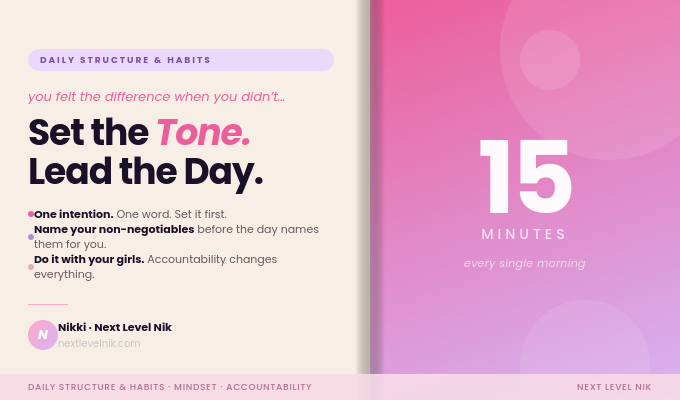
Why Your Day Feels Chaotic Before It Even Starts (And the 15-Minute Fix That Actually Works)
Some Days Just Flow. Others Feel Like You're Dragging Yourself Through Mud.
You know the difference.
There are days when you wake up, get into your work, check things off your list, and actually feel good doing it. And then there are the other days — the ones where even the tasks you know you need to handle feel like pulling teeth. You sit down to work and somehow an hour passes, nothing's done, and you can't quite explain why you feel so off.
It's not laziness. It's not a lack of discipline. And it's definitely not a character flaw.
It's the absence of intention.
Because here's what most people don't realize: without deliberately setting the tone for your day, your brain defaults to reactive mode. You move through hours responding to whatever shows up rather than leading your day on your own terms. The difference between a day that flows and one that doesn't is almost always what happened — or didn't happen — in those first few minutes.
The Quiet Power of a Daily Intention Practice
An intention is not a to-do list. It's not a goal. And it's not a motivational quote you read and forget by 9am.
A daily intention is a decision — a conscious choice about how you want to show up, what you want to prioritize, and the energy you want to bring before the day starts pulling you in fifteen directions.
When you set an intention, you're essentially giving your brain a filter. It now knows what to focus on, what to protect, and what to let slide. Neuroscience backs this up: the reticular activating system (RAS) in your brain acts like a search engine — it surfaces whatever you've told it matters. Set an intention to be disciplined and handle your priorities first, and your brain goes to work making that happen, almost automatically.
That's not magic. That's your mind doing what it was always capable of — just finally given a clear instruction.
How to Build a Daily Intention Practice That You'll Actually Keep
The honest truth? Knowing about intention setting and actually doing it every single day are two very different things. Most of us have tried — journaling prompts, apps, sticky notes on the mirror — and still fallen off after a week.
Here's what makes the difference.
Start Small — 15 Minutes Is More Than Enough
You don't need a two-hour morning ritual. A focused 15-minute intention session each day is enough to completely shift how you move through the rest of your hours. Try this simple structure:
Step 1: Check in with yourself.
Before you check your phone, email, or anyone else's energy — pause. How are you actually feeling? What's already pulling at your attention?
Step 2: Choose your intention.
Pick one word, focus, sentence, or mantra for the day. Not ten. One. Discipline. Presence. Focus. Productivity. Let that anchor everything else.
Step 3: Identify your non-negotiables.
What are the one to three things that must get done today — the tasks that will actually move your life and work forward? Name them out loud or write them down.
Step 4: Set the tone intentionally.
Take a few minutes to breathe, pray, journal, or simply sit in stillness. This isn't wasted time. This is you deciding who's driving your day — you, or everything else.
Want to make your intentions visible and your habits trackable? The Goal & Habit Tracker is a simple Google Sheets tool that helps you stay consistent — so your intentions actually translate into action.
The Part That Makes It Actually Stick: Accountability
Here's where most people leave results on the table — they try to do this alone.
And doing it alone isn't impossible, but let's be honest: the days you most need to set an intention are usually the days you feel least like doing it. That's exactly where community changes the game.
When you're held accountable by people who show up with you every day, the practice stops feeling optional. You stop negotiating with yourself. You just do it — and then you notice how much easier everything that follows becomes.
Whether it's a friend, a group chat, or a structured space built around daily accountability and growth, find your people. The right circle doesn't just keep you consistent — it actively raises your standard.
If you've been trying to build habits and routines alone and keep falling off, that's worth looking at. The Next Level Blocker Quiz helps you identify exactly what's getting in the way — so you can stop repeating the same cycle.
Imagine Starting Every Day Already Ahead
Picture this: before the notifications, before the emails, before anyone asks anything of you — you've already decided who you are today. You've named your focus. You've committed to your priorities. And because of that, when the day inevitably gets loud, you don't get swept away by it.
Tasks that used to feel like pulling teeth? You just handle them. Not because you magically became a different person, but because you showed up for yourself first — and that changes everything that comes after.
This is what a consistent intention practice does over time. It stops being something you do and becomes something you are. A woman who leads her day. Someone who sets the tone before the world tries to set it for her. Someone her future self will be genuinely grateful for.
That version of you isn't far away. She's 15 minutes away — every single morning.
Looking for a community that does this with you? The Next Level Collective is where we show up every day, set our intentions together, and hold each other accountable to actually following through. Come do life with us.
Key Takeaways
- Reactive days are a signal, not a character flaw — the absence of intention leaves your brain without direction.
- An intention is a decision, not a to-do list. One word. One. sentence. One focus. Set it before the day sets you.
- Your brain works with you when you give it a clear filter — neuroscience supports this, and your lived experience already knows it.
- 15 minutes is enough to completely shift the energy, discipline, and flow of your entire day.
- Accountability accelerates everything — the days you most need this practice are the days you're least likely to do it alone.
- Community isn't a bonus — for many women, it's the exact thing that makes the difference between knowing and actually doing.
Resources
Everything mentioned in this post, in one place:
- 📋 Goal & Habit Tracker (Google Sheets) — Track your daily intentions and habits so nothing slips through the cracks.
- 🔍 Next Level Blocker Quiz — Find out what's actually keeping you from showing up consistently for yourself.
- 🌸 Next Level Collective — A community of ambitious women who set their intentions together every single day. This is where the accountability lives.
FAQ
Q: What's the difference between setting an intention and writing a to-do list? A to-do list tells you what to do. An intention tells you who to be while you do it. They work best together — but the intention always comes first.
Q: What if I don't know what my intention should be? Start with how you want to feel by the end of the day. Grounded? Accomplished? Focused? Work backward from that feeling and let it guide your word or focus for the day.
Q: Do I have to do this in the morning? Morning works best because you're setting the tone before external demands kick in — but any consistent time beats no time at all. Even five minutes before you start work counts.
Q: What if I miss a day? You come back. That's it. The practice isn't ruined because you missed a day — it only becomes a pattern if you stop coming back.
Your day is always going somewhere. The only question is whether you decide where — or let everything else decide for you.

Comments